
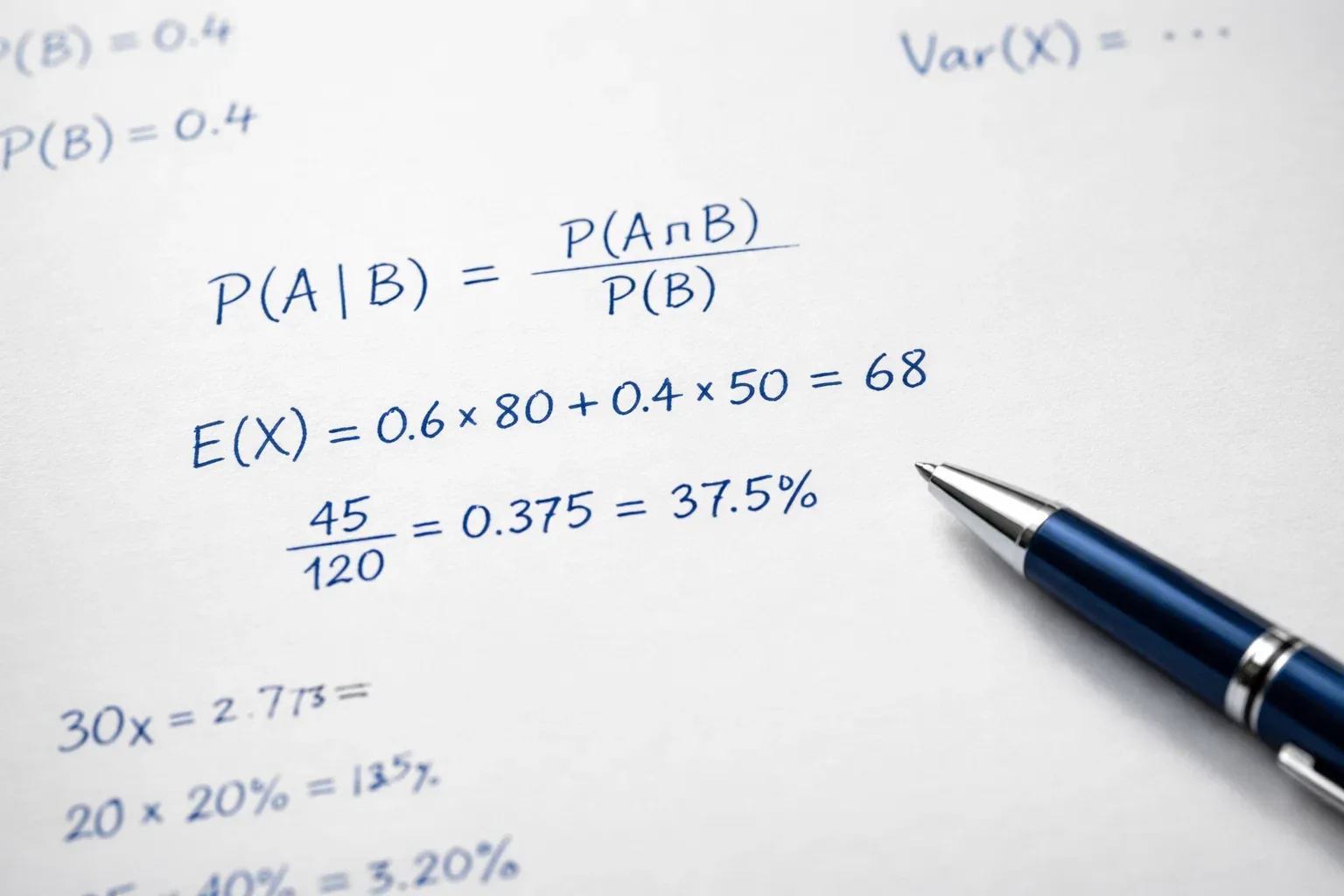
The Kelly Criterion stands as perhaps the most elegant solution to a question every serious bettor faces: how much should I stake on this bet? Developed by John Kelly at Bell Labs in 1956, this formula mathematically determines the stake size that maximises long-term bankroll growth. While originally designed for information theory applications, its adaptation to betting and investment has made it a cornerstone of professional gambling strategy. This guide explains the criterion from first principles, walks through practical calculations, addresses its limitations, and provides guidance on implementation.
The Mathematical Foundation
The Kelly Criterion solves an optimisation problem: given your edge and the odds, what bet size produces the fastest possible bankroll growth over time? Too small and you leave money on the table; too large and you risk catastrophic losses that set you back disproportionately. Kelly finds the precise balance.
The formula in its simplest form is: stake percentage equals (bp minus q) divided by b. Here, b represents the decimal odds minus one (your profit per unit staked if you win), p represents your probability of winning, and q represents your probability of losing (which equals one minus p). The output tells you what fraction of your bankroll to stake.
Alternatively, for those working with decimal odds directly: stake percentage equals (probability times decimal odds minus one) divided by (decimal odds minus one). Both formulations produce identical results; choose whichever feels more intuitive for your workflow.
The mathematics behind Kelly relates to logarithmic utility functions and geometric mean maximisation. Without delving into the proofs, the key insight is that maximising expected bankroll growth requires considering both the probability of outcomes and their magnitudes. Kelly achieves this by sizing bets proportionally to edge while never risking enough to create unrecoverable losses.
Worked Example Calculations
Consider a football match where your analysis suggests the home team has 55% probability of winning. Bookmakers offer 2.00 decimal odds (evens in fractional terms). Your edge exists because fair odds for 55% probability would be 1.82, yet you’re receiving 2.00.
Using the Kelly formula: stake percentage equals (0.55 times 2.00 minus 1) divided by (2.00 minus 1). This calculates as (1.10 minus 1) divided by 1, equalling 0.10 or 10% of your bankroll.

If your bankroll is £1,000, Kelly recommends staking £100 on this bet. The expected value is positive because 55% times £100 profit minus 45% times £100 loss equals £10 expected profit per bet, or 1% of bankroll.
Now consider a longer odds example. You assess an underdog at 30% win probability while bookmakers offer 4.00 decimal odds. Fair odds for 30% would be 3.33, so you have edge. Kelly calculates: (0.30 times 4.00 minus 1) divided by (4.00 minus 1), equalling (1.20 minus 1) divided by 3, equalling 0.067 or 6.7% of bankroll.
Notice that despite having edge at both odds levels, the Kelly stake differs substantially. The formula accounts for both edge magnitude and odds structure, producing context-appropriate recommendations rather than flat percentages.
Understanding the Formula’s Logic
Kelly stakes larger when your edge is larger. A bet where you have 8% edge commands more of your bankroll than one where you have 3% edge. This seems obvious but many bettors ignore it, betting the same amount regardless of edge magnitude.
Kelly stakes smaller at higher odds for equivalent edge percentages. Compare 55% probability at 2.00 odds (10% stake) versus 30% probability at 4.00 odds (6.7% stake). Both have approximately 10% edge over fair odds, yet optimal stakes differ because higher odds mean higher variance. The formula accounts for the increased probability of losing when backing longshots.
Kelly never recommends betting when you lack edge. If fair probability equals or exceeds your estimated probability, the formula produces zero or negative output. Negative Kelly output indicates you should bet the opposite side if possible. This automatic edge checking prevents betting on negative expected value propositions.
The formula assumes your probability estimates are accurate, a critical assumption we’ll address later. It also assumes you bet sequentially, adjusting bankroll between bets. In practice, most bettors place multiple simultaneous bets, requiring modifications we’ll discuss.
Fractional Kelly: The Practical Modification
Full Kelly maximises long-term growth rate but produces extreme volatility. A full Kelly bettor faces roughly 33% probability of halving their bankroll before doubling it. This mathematical reality proves psychologically intolerable for most people and operationally problematic for betting accounts that might get restricted.
Fractional Kelly addresses this by staking only a portion of the full Kelly recommendation. Half Kelly stakes 50% of the calculated amount; quarter Kelly stakes 25%. These fractions substantially reduce volatility while only modestly reducing long-term growth rate.
The reduction in volatility proves dramatic. Half Kelly drops the probability of halving before doubling from 33% to roughly 11%. Quarter Kelly reduces it further to perhaps 5%. For most bettors, this volatility reduction more than compensates for the reduced growth rate.
Professional bettors typically employ Kelly fractions between 25% and 50%. Very few use full Kelly despite its theoretical optimality. The professionals understand that surviving to bet another day matters more than maximising growth rate in any single period.
Simultaneous Bets and Portfolio Considerations
The original Kelly formula assumes sequential betting with bankroll adjustments between bets. Real football betting involves multiple simultaneous selections, often on the same matchday. This creates complications that require adjustment.
The simplest approach treats simultaneous bets independently but reduces the Kelly fraction accordingly. If you typically place ten bets per weekend, using one-tenth Kelly per bet produces aggregate exposure similar to full Kelly on a single bet. This rough heuristic prevents over-betting when multiple selections occur simultaneously.
More sophisticated approaches calculate correlated exposure across bets. If you’re backing unders in multiple matches featuring defensive teams, those bets share exposure to the proposition that defensive football produces low-scoring games. A defensive football collapse would harm all simultaneously. Accounting for correlation reduces optimal stakes on correlated bets.
In practice, most bettors handle this by using conservative Kelly fractions that remain appropriate even when multiple bets are active. Quarter Kelly per bet, even with twenty active bets, produces manageable aggregate exposure for most bankroll sizes.
Probability Estimation: The Critical Input
Kelly’s output is only as good as your probability input. If you estimate 55% probability but true probability is 48%, Kelly tells you to stake 10% on a negative expected value bet. The formula cannot detect estimation errors; it simply optimises based on whatever probability you provide.
This sensitivity to probability estimates makes Kelly dangerous for bettors who overestimate their edge. If you consistently think your edge is larger than it actually is, Kelly amplifies your mistakes by staking more than you should. The formula turns overconfidence into accelerated losses.
Conservative probability estimates provide protection against this failure mode. Rather than estimating 55% when you think 55%, estimate 53% and calculate Kelly accordingly. This buffer accounts for estimation error and produces smaller stakes that remain appropriate even if you’re somewhat wrong.
Model-based bettors with calibrated probability estimates can use Kelly more aggressively. If your historical probabilities correlate strongly with actual outcomes, you can trust your estimates more fully and employ larger Kelly fractions. But even well-calibrated models occasionally fail, suggesting some conservatism remains prudent.
Building Your Own Kelly Calculator
A simple Kelly calculator requires only basic spreadsheet skills. Create columns for: decimal odds, your estimated probability, and bankroll size. The stake calculation is straightforward: equals bankroll times ((probability times odds minus 1) divided by (odds minus 1)).
Add a Kelly fraction input to easily adjust between full, half, or quarter Kelly. Your final stake formula multiplies the basic Kelly output by your chosen fraction. Include a check that outputs zero when Kelly produces negative values, preventing the display of invalid stakes.
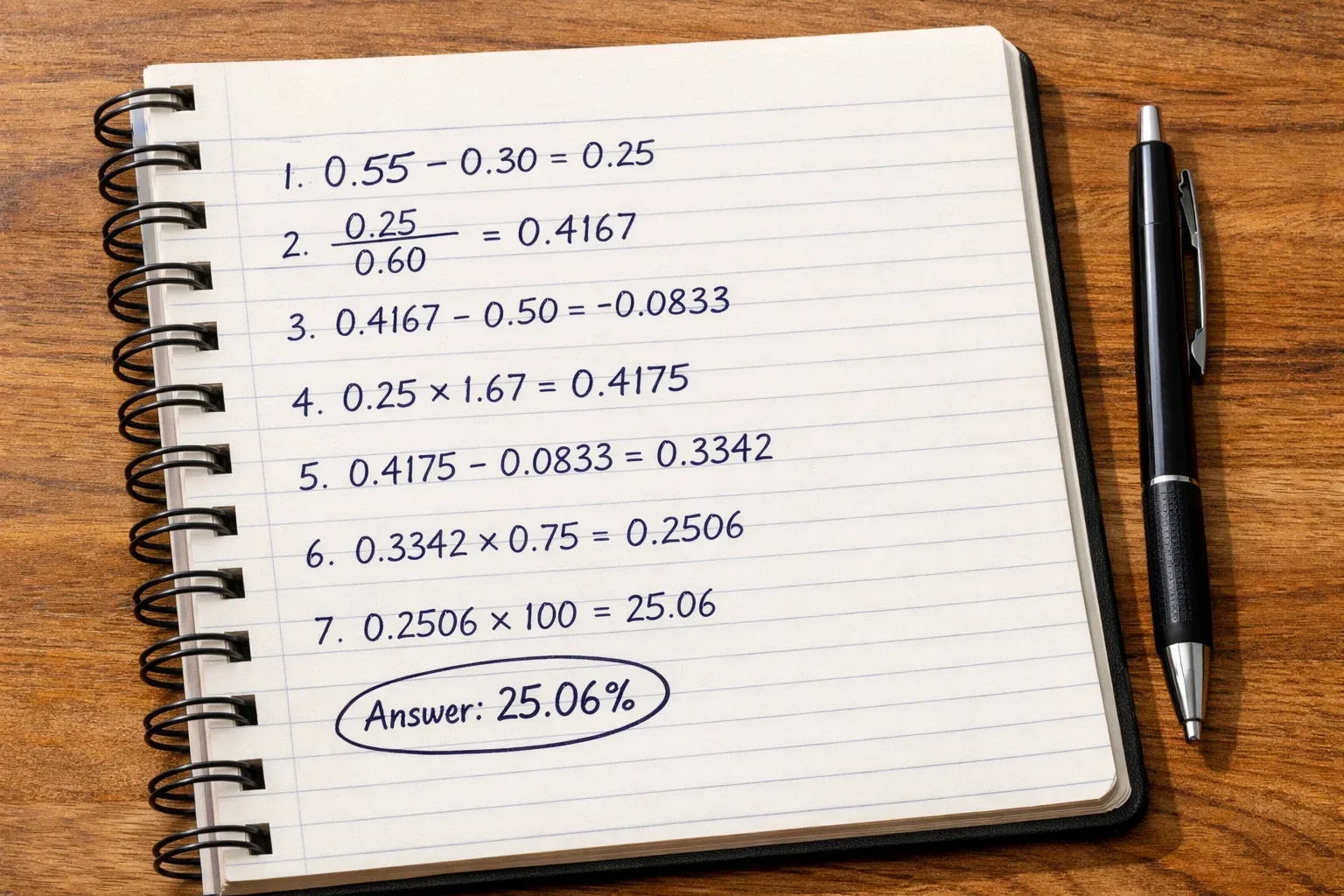
For convenience, add a maximum stake cap. Even if Kelly recommends 20% of bankroll, you might cap at 5% to prevent any single bet from causing excessive damage. This additional conservatism beyond fractional Kelly provides extra protection against model errors.
Online Kelly calculators exist if you prefer not to build your own. Numerous betting tools sites offer free calculators where you input odds and probability to receive stake recommendations. These work fine for occasional use, though serious bettors benefit from integrated spreadsheet systems that track bets alongside Kelly calculations.
Read our complete asian handicap guide.
Common Implementation Mistakes
The most frequent error involves using odds as probability. Beginners sometimes enter the odds into the probability field, producing nonsensical outputs. Probability must be your own independent estimate of win likelihood, typically derived from analysis rather than market prices.
Using the wrong odds format creates calculation errors. Kelly formulas typically require decimal odds. Using fractional odds or American odds without conversion produces incorrect stakes. Convert to decimal before calculating, or use a calculator specifically designed for your preferred odds format.
Ignoring the negative output trips up many bettors. When Kelly produces a negative number, this indicates you should bet the other side or not bet at all. Some bettors interpret negative outputs as small positive stakes, converting losing propositions into actual bets.
Failing to update bankroll regularly causes stake drift. Kelly percentages should apply to current bankroll, not original bankroll. If you started with £1,000 but now have £1,500, your 10% Kelly stake is £150, not £100. Periodic bankroll updates, at minimum weekly, keep stakes appropriately sized.
When Not to Use Kelly
Kelly assumes infinite time horizons and no betting constraints. Real bettors face account restrictions, liquidity limits, and finite betting careers. These constraints sometimes make Kelly suboptimal compared to simpler approaches.
When your edge estimates carry high uncertainty, flat staking often outperforms Kelly. The formula amplifies estimation errors; if your probability assessments are unreliable, Kelly stakes will be systematically wrong. Better to stake modestly across all selections than to stake heavily on the wrong ones.
Very small bankrolls relative to minimum bet sizes make Kelly calculations impractical. If Kelly recommends £2 but the minimum stake is £5, you cannot implement optimal sizing. Either stake the minimum (accepting oversizing) or skip the bet entirely.
When emotional discipline is uncertain, simpler approaches prove superior. Kelly requires following calculated recommendations even when they feel wrong. If you’ll override Kelly outputs based on gut feeling, you’re not actually using Kelly; you’re using gut feeling with Kelly-flavoured justification. Be honest about what approach you’ll actually follow.
Advanced Kelly Considerations
Kelly for lay betting requires adjusting the formula to account for the lay structure. When laying, your liability is stake times (odds minus one), not stake alone. The Kelly formula for laying becomes: stake percentage equals (fair probability minus lay probability) divided by (lay odds minus 1), where probabilities refer to the outcome happening.
Simultaneous bet optimisation can employ Kelly’s portfolio extension. Rather than treating bets independently, solve for the stake combination that maximises growth across all concurrent bets accounting for their correlations. This approach is computationally intensive and rarely necessary for recreational bettors.
In-play Kelly adjustments reflect changing probability as matches progress. If you backed a team at 55% pre-match but they’re now winning and 80% likely to complete victory, your optimal exposure differs. Some sophisticated bettors recalculate Kelly throughout matches and adjust positions accordingly.
Realistic Expectations and Long-Term View
Kelly provides optimal growth rate given accurate probability estimates, not guaranteed profits. Even optimal staking loses money when selections carry negative expected value. The formula is a staking tool, not a selection tool; it cannot substitute for genuine betting edge.
Expect significant volatility even with fractional Kelly. Your bankroll will fluctuate substantially on the way to long-term growth. Streaks of losses will occur and will feel terrible despite being statistically expected. The emotional journey of Kelly-based betting challenges most participants.
Long-term growth compounds powerfully when Kelly works correctly. A bettor generating 5% expected return per bet cycle with appropriate Kelly sizing will see exponential bankroll growth over years. This compounding effect justifies Kelly’s complexity for bettors with genuine, persistent edge.
Kelly has served professional gamblers and investors for nearly seventy years because it works mathematically. Whether it works for you depends on the accuracy of your probability estimates, the discipline of your implementation, and your tolerance for the volatility inherent in optimal growth strategies.
Avoid strict market limits via burnley bet.