

Asian handicap betting transformed football wagering when it migrated from Southeast Asian markets to global bookmakers in the early 2000s. What began as a regional betting format became the preferred choice of sharp bettors worldwide because it eliminates the draw, reduces bookmaker margins, and creates opportunities for value that traditional markets simply cannot match. This guide walks through Asian handicaps from absolute fundamentals through advanced strategic applications, with particular focus on how defensive teams can be leveraged through handicap betting.
The Core Concept Explained
Traditional football betting offers three outcomes: home win, draw, away win. Asian handicap reduces this to two outcomes by applying a goal handicap to one team before kickoff. If you back Manchester City at -1.5 goals against a weaker opponent, City starts the match at -1.5 in handicap terms. They must win by two or more goals for your bet to succeed. Conversely, backing the opponent at +1.5 means they start with a virtual 1.5 goal advantage; they can lose by one goal, draw, or win, and you still collect.
The elimination of draws matters enormously. In standard 1X2 betting, approximately 25-27% of matches end level, creating dead heat scenarios that frustrate bettors backing either team. Asian handicaps sidestep this entirely through half-goal lines. Because you cannot score half a goal in actual football, every match produces a clear winner in handicap terms. Your selection either covers the handicap or it doesn’t.
This binary outcome structure reduces bookmaker margins compared to three-way markets. With only two outcomes to price, bookmakers typically operate at 3-4% overround on Asian handicaps versus 5-7% on 1X2 markets. That margin difference compounds significantly over hundreds of bets. Sharp bettors gravitate toward Asian handicaps partly for the improved mathematics and partly for the nuanced betting options they provide.
Understanding Different Handicap Lines
The half-goal lines like +0.5 and -0.5 represent the simplest Asian handicaps. Backing a team at +0.5 means they start with a half-goal advantage; they must avoid defeat for your bet to win. This is functionally identical to “double chance” betting (team to win or draw) but typically offers better odds due to reduced bookmaker margins. The -0.5 line means backing a team to win; anything less than victory loses the bet.
The +1.5 and -1.5 lines feature prominently in matches between mismatched teams. A strong favourite might be available at -1.5, requiring them to win by two or more goals. The underdog at +1.5 wins if they lose by just one goal, draw, or win outright. Championship matches frequently see these lines when promotion candidates visit struggling sides. The question becomes whether the favourite’s superiority translates into multi-goal victories consistently.
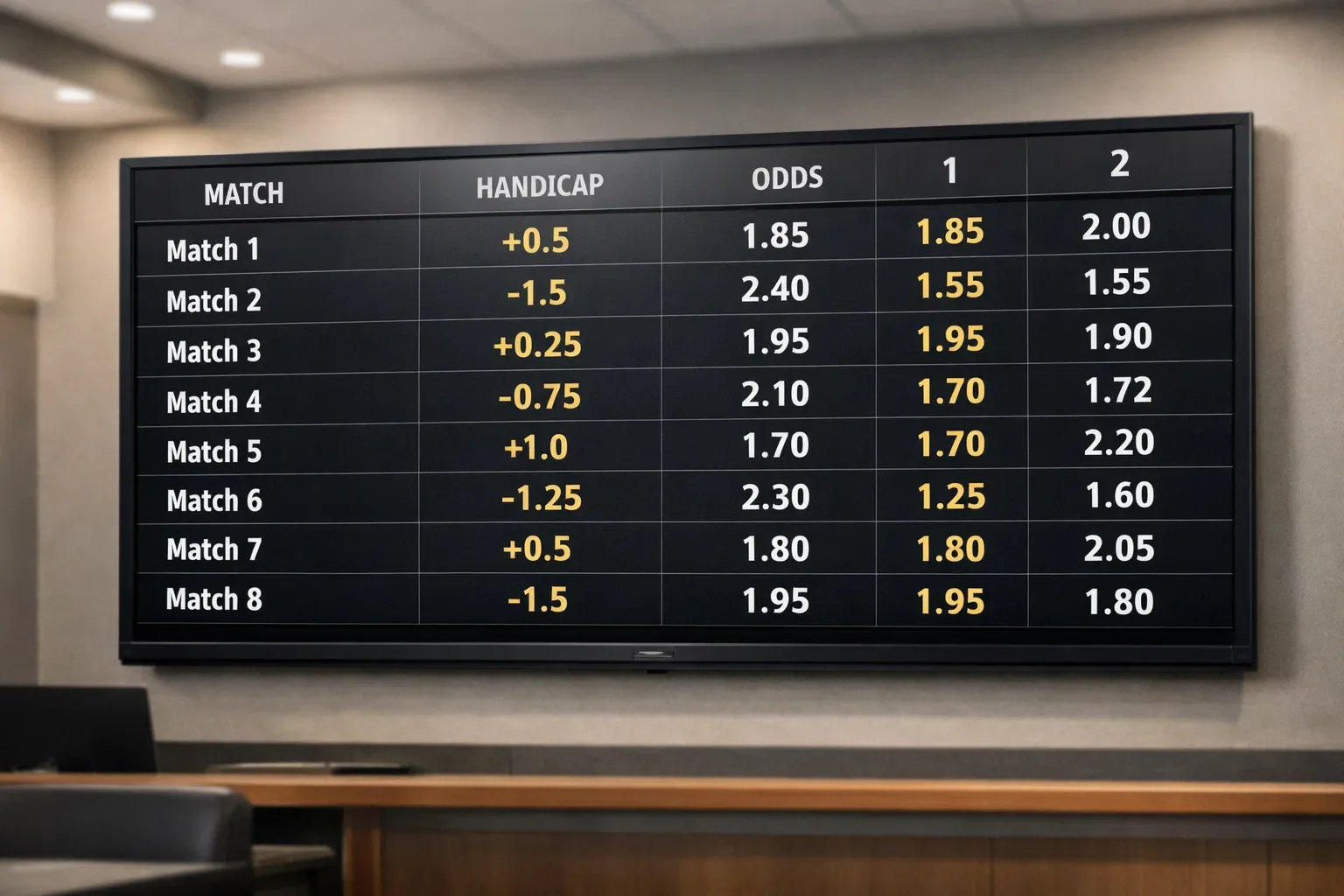
Whole number handicaps like 0, -1, and +1 introduce the possibility of “pushes” where stakes return. If you back a team at -1 and they win by exactly one goal, the handicap adjustment produces a draw and your stake comes back. This provides partial protection against narrow victories but obviously delivers no profit in such scenarios.
Quarter-goal handicaps like -0.25, -0.75, +1.25 split your stake between two adjacent lines. Backing a team at -0.75 means half your stake goes on -0.5 and half on -1. If your team wins by exactly one goal, you win half your bet (the -0.5 portion) and push on the other half (the -1 portion). These split lines allow bookmakers to offer more precise pricing and give bettors additional calibration options when standard lines don’t quite fit their analysis.
Why Defensive Teams Thrive in Handicap Markets
Teams that defend well but lack attacking firepower often create excellent handicap opportunities. Consider a defensively solid Championship side that typically wins matches 1-0 or draws 0-0. In traditional match betting, they’re difficult to back because their narrow victories don’t compensate adequately for the draws they produce. But in handicap markets, particularly the +0.5 away line, their defensive resilience becomes a weapon.
A team that rarely loses by more than one goal makes the +1.5 handicap almost automatic in many fixtures. Even against significantly stronger opposition, if they can limit damage to a single goal defeat, backers of +1.5 collect. Historical data often shows certain defensive teams covering +1.5 in 85%+ of their away matches simply because they refuse to capitulate regardless of opponent quality.
The +0.5 handicap, equivalent to backing a team to avoid defeat, suits defensive sides playing at home. A team that draws frequently frustrates traditional match bettors but rewards +0.5 backers consistently. If a side draws 35% of home matches and wins 40%, the +0.5 line wins 75% of the time. When bookmakers price +0.5 at odds implying 70% probability, genuine value exists.
Asian handicap also exposes value in matches between defensive teams. When two sides with excellent defensive records meet, bookmakers often struggle to price the market correctly. The total goals market might be efficiently priced, but handicap markets can reflect outdated assessments of relative strength. Backing the perceived underdog at +0.5 in these defensive stalemates frequently delivers value.
Calculating Value in Asian Handicaps
Value assessment in Asian handicaps requires estimating probability of each team winning by specific margins. Standard match result analysis considers only win, draw, loss. Handicap analysis must distinguish between winning by one goal versus two goals versus three or more. These margin probabilities determine which handicap line offers genuine value.
Expected goals data helps project scoring margins. If analysis suggests Team A should beat Team B with expected scoreline around 2-0.7, that implies most likely victories come by one or two goals. The probability of -1.5 covering depends on how often the expected distribution produces two-goal winning margins. In this example, probably around 35-40% of outcomes cover -1.5, while 55-60% cover -0.5.
Comparing your probability estimates against bookmaker odds reveals where value lies. If you calculate -1.5 covering 38% of the time and bookmakers offer odds of 2.10 (implied probability 47.6%), there’s no value despite seeming like the favourite should win comfortably. Conversely, +1.5 at 1.80 (implied 55.6%) when you estimate 62% true probability offers significant edge.
Historical margin data by team provides useful calibration. Some teams consistently win by tight margins regardless of opponent quality; others either dominate or lose. Understanding these patterns helps assess which handicap lines suit particular teams. A side that wins 2-0 or 3-1 regularly differs from one that wins 1-0 through defensive grit and opportunistic finishing.
Strategic Application Approaches
The simplest handicap strategy involves backing heavy underdogs at +1.5 or greater when they possess defensive solidity. These teams might rarely win outright, making traditional match betting unprofitable, but their ability to limit damage means handicap coverage rates exceed what odds suggest. Identify teams with low expected goals against and strong set-piece defending; they’ll cover large handicaps consistently.
Conversely, backing moderate favourites at -0.5 (to win) often offers better value than traditional 1X2 win lines. The odds difference might seem marginal, but accumulated over a season, the superior Asian handicap margins compound into meaningful profit differential. If your analysis favours a team to win, placing that bet in handicap format rather than match result format simply extracts better prices.

The alternative handicap approach targets contrarian lines. When public money floods toward obvious favourites on the -1.5 line, bookmakers sometimes adjust their pricing in ways that create value on the +1.5 underdog side. Tracking line movement and identifying when market pressure distorts fair value creates opportunities that raw match analysis wouldn’t reveal.
Live betting on Asian handicaps adds another dimension. In-play handicap lines shift continuously based on score, time elapsed, and match dynamics. A team losing 1-0 sees their handicap adjusted to reflect the deficit. Sharp bettors recognising when in-play adjustments overreact to early goals can find exceptional value. A team down 1-0 but dominating possession might see exaggerated +0.5 live odds that overprice their comeback probability.
Browse the required championship stats online.
Championship-Specific Handicap Opportunities
The Championship’s competitiveness creates handicap value that more stratified leagues lack. Unlike the Premier League where elite teams routinely cover large handicaps against relegation fodder, Championship matches feature tighter margins. The gap between first and twentieth place is smaller, meaning fewer fixtures warrant handicaps beyond +1/-1.
Home advantage in the Championship sometimes exceeds bookmaker handicap adjustments. Certain grounds develop reputations as difficult venues where visitors consistently underperform expectation. Backing home underdogs at +0.5 in these environments exploits value that aggregate statistics mask. Conversely, some away sides travel exceptionally well, making them better -0.5 candidates than league position suggests.
Fixture congestion impacts Championship handicaps more than top-flight equivalents. With more games, less depth, and tighter schedules, fatigue effects accumulate. Teams playing their third match in eight days rarely cover large handicaps even if nominally superior. Identifying when squad strain undermines expected performance allows profitable betting against tired favourites.
The promotion and relegation battle intensity shifts handicap dynamics seasonally. Teams desperately needing points become difficult to predict; they might capitulate under pressure or find previously absent resilience. The uncertainty these high-stakes matches create often sees bookmakers widen lines, potentially creating value on both sides depending on your read of how desperation manifests in particular fixtures.
Common Mistakes in Handicap Betting
The most prevalent error involves backing favourites at handicaps they cannot realistically cover. A team that wins 60% of matches but only 25% of those by two or more goals makes the -1.5 a losing proposition long-term regardless of how good they appear. Understanding winning margin distributions matters more than understanding who wins most often.
Another mistake is treating handicap betting as simply “backing or opposing the favourite.” Asian handicaps offer nuance that binary thinking abandons. The question isn’t whether to back the favourite but at which handicap line their edge translates into value. A favourite might be excellent at -0.5, marginal at -1, and terrible at -1.5. Each represents different propositions requiring separate analysis.
Ignoring the push scenarios in whole-number handicaps leads to suboptimal decisions. When backing a team at -1, the probability of exactly one-goal victory affects expected return significantly. If your team wins by one goal frequently, pushing means breaking even on many bets. Whether that’s acceptable depends on the odds offered and alternative lines available.
Finally, many bettors fail to shop lines adequately. Different bookmakers offer different handicaps and odds. One site might list +0.75 at 1.95 while another offers +0.5 at 2.10. Depending on your probability assessment, either could represent better value. Having multiple accounts and checking lines across providers before placing handicap bets captures edge that single-bookmaker bettors surrender.
Building Handicap Analysis Into Your Routine
Effective handicap betting requires systematic data collection. Track winning margins for teams you follow, noting how often they win by one goal, two goals, or more. Record their performance against different quality opponents. Build your own margin probability tables rather than relying entirely on bookmaker pricing, which reflects balanced book targets alongside probability estimates.
Integrate handicap analysis with other betting markets. Your under 2.5 goals research overlaps with handicap considerations; low-scoring matches tend to produce tight margins. If backing under 2.5 in a particular fixture, the handicap lines likely favour conservative positions too. Cross-referencing insights across markets validates your analysis and identifies betting combinations offering correlated value.
Review historical handicap results regularly. Which handicap lines have you profited on? Which have cost money? Pattern recognition across your betting history reveals where your analysis provides genuine edge versus where you’ve been lucky or unlucky. Adjusting your approach based on empirical results, rather than theoretical confidence, separates evolving bettors from static ones.
Asian handicap betting rewards analytical rigour and mathematical understanding. It punishes lazy assumptions and rewards those who genuinely estimate margin probabilities rather than simply guessing which team is better. For bettors willing to develop these skills, handicaps offer superior value and reduced variance compared to traditional markets. The learning curve is real, but the payoff justifies the investment.
Follow carefully proven methods using burnley bet.