

The question of how much to bet matters almost as much as what to bet on. A profitable selection strategy paired with destructive staking approach will still lose money over time, while a modest edge combined with disciplined stake management can generate substantial long-term returns. This guide examines the two fundamental approaches to stake sizing, flat and variable, analysing their mathematical properties, psychological implications, and practical applications for football bettors.
Understanding Flat Staking
Flat staking means betting the same amount on every selection regardless of odds, confidence level, or any other factor. If you decide to stake two units per bet, every single wager receives exactly two units whether you’re backing a 1.50 favourite or a 5.00 outsider, whether you feel supremely confident or merely hopeful. The simplicity is absolute and deliberate.
The mathematical foundation of flat staking assumes that your edge is roughly constant across selections. If you genuinely cannot distinguish between bets where you have large edge versus small edge, treating them equally makes sense. You’re acknowledging uncertainty about edge magnitude while maintaining discipline about total exposure. Each bet receives identical weight because you have no reliable basis for weighting them differently.
Flat staking provides the cleanest possible test of whether your selection method actually works. If you cannot profit using flat stakes, no staking system will rescue you. This diagnostic value proves crucial for bettors developing their analytical approaches. Before experimenting with complex stake sizing, verify that your underlying selections generate positive expected value when weighted equally. Many bettors skip this step, masking unprofitable selection with temporarily lucky stake weighting.
The psychological benefits of flat staking often exceed the mathematical considerations. Removing stake size decisions eliminates one avenue for emotional interference. You cannot chase losses by increasing stakes, cannot let overconfidence inflate bets on “certainties,” cannot let fear shrink stakes when you should trust your analysis. The discipline is externally imposed through system design rather than relying on willpower that fails under pressure.
The Mechanics of Variable Staking
Variable staking adjusts bet size based on some criterion, typically perceived edge magnitude or confidence level. A bettor might stake one unit on marginal selections, two units on solid picks, and three units on their strongest convictions. The stake reflects not just whether to bet but how much the bet is worth pursuing.
The theoretical justification for variable staking centres on edge optimisation. If you genuinely know when your edge is larger versus smaller, concentrating stakes on high-edge situations and minimising exposure on low-edge situations should improve returns. Betting three units when you have 8% edge beats betting one unit; betting one unit when you have 2% edge minimises exposure when things go wrong.
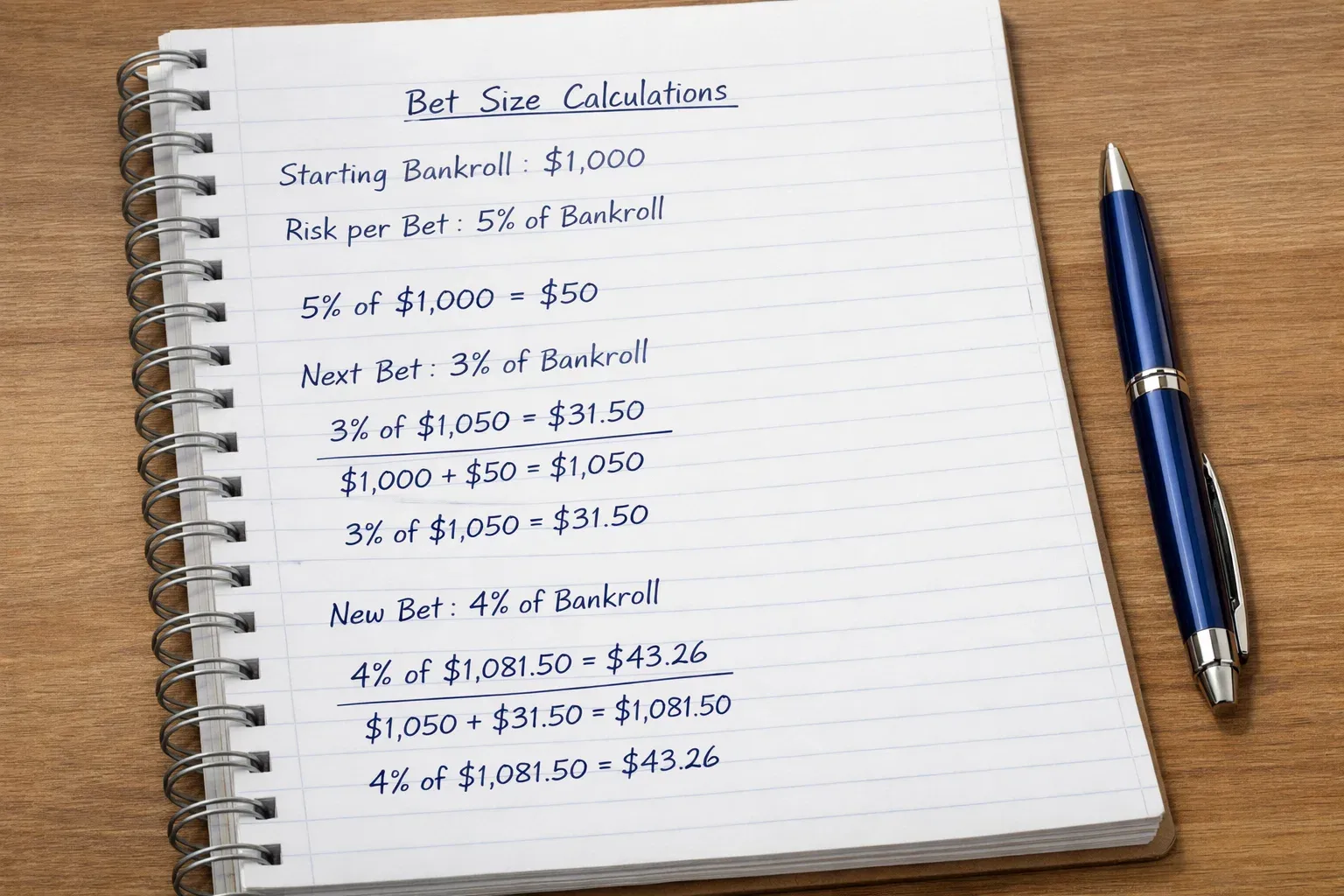
The Kelly Criterion represents the mathematically optimal variable staking approach. This formula, developed by John Kelly at Bell Labs in 1956, calculates the stake size that maximises long-term bankroll growth given your edge and the odds offered. For a bet with 55% true probability at 2.00 odds, Kelly recommends staking 10% of your bankroll. The formula accounts for both the probability of winning and the payoff structure.
Kelly’s formula is straightforward: stake percentage equals (probability times odds minus one) divided by (odds minus one). At 2.00 odds with 55% probability, this yields (0.55 times 2 minus 1) divided by (2 minus 1), equalling 0.10 or 10%. The elegance masks significant practical challenges that we’ll examine shortly.
Comparing Mathematical Properties
Flat staking produces linear bankroll growth when your selections carry positive expected value. Win five bets at 2.00 odds with two-unit stakes and you’re up ten units. The growth rate stays constant regardless of bankroll size because stake size doesn’t change. Over long timeframes, this produces steady accumulation that’s easy to track and project.
Variable staking, particularly Kelly-based approaches, produces geometric growth through compounding. As your bankroll grows, stakes increase proportionally, accelerating gains. A 5% return on a larger bankroll produces larger absolute profit than the same 5% return on the original smaller bankroll. This compounding effect makes optimal variable staking theoretically superior for long-term wealth maximisation.
However, variance differs dramatically between approaches. Flat staking produces predictable fluctuations based on your strike rate and average odds. Variable staking, especially full Kelly, creates much larger swings. A full Kelly bettor has approximately one-third probability of halving their bankroll before doubling it. This volatility, while mathematically acceptable for infinite time horizons, proves psychologically devastating for actual human bettors.
The practical compromise involves fractional Kelly staking, typically half Kelly or quarter Kelly. These reduce recommended stake sizes proportionally, trading some growth rate for substantially reduced volatility. Half Kelly, for example, has only one-ninth probability of halving before doubling, making the experience much more tolerable. Most professional bettors using Kelly-style approaches employ fractional versions.
When Flat Staking Works Best
Flat staking suits bettors who bet across narrow odds ranges. If all your selections fall between 1.80 and 2.20 odds, the risk-return profile varies little between bets. Staking the same amount on each makes practical sense because the bets themselves are roughly equivalent in structure. Variable staking adds complexity without proportionate benefit in this scenario.
Beginners benefit enormously from flat staking regardless of their odds range. The simplicity allows concentration on selection quality rather than stake calculation. The diagnostic clarity reveals whether your analysis actually generates edge. The psychological protection prevents the emotional decision-making that destroys beginner bankrolls. Only after demonstrating profitability with flat stakes should beginners consider variable approaches.
Bettors who cannot reliably assess their own edge should stick with flat staking. Variable staking only improves results if you correctly identify when your edge is larger versus smaller. If your confidence levels don’t correlate with actual edge, variable staking amplifies mistakes by placing larger bets on selections where you’re overconfident. Flat staking avoids this failure mode entirely.
High-volume bettors sometimes prefer flat staking for operational efficiency. Calculating Kelly stakes for hundreds of daily selections requires systems and time that simpler approaches avoid. The marginal theoretical advantage of optimal staking might not justify the implementation costs for operations at scale. Many successful betting syndicates use flat or near-flat staking for precisely this reason.
When Variable Staking Works Best
Variable staking excels when you can genuinely distinguish between high and low edge situations. If your analysis produces probability estimates that correlate strongly with actual outcomes, staking proportionally to edge captures more value. The ability to say “this is a 60% proposition” versus “this is a 52% proposition” with reasonable accuracy enables profitable variable staking.
Bettors working across wide odds ranges benefit from variable staking that accounts for odds structure. Staking the same amount on 1.30 odds as on 4.00 odds creates unbalanced risk exposure. A stake adjustment that equalises potential profit or potential loss across different odds produces more consistent bankroll behaviour than pure flat staking.
Model-based bettors whose systems produce explicit probability estimates are natural candidates for Kelly-style staking. If your model says Team A has 58% win probability against odds implying 50%, you know your edge. If another selection shows 53% versus implied 50%, you know that edge is smaller. Kelly translates these edge estimates into proportional stakes automatically.
Long-term focused bettors willing to accept short-term volatility for maximised growth rate can employ full or aggressive Kelly approaches. If you genuinely don’t need your bankroll for other purposes and can emotionally tolerate halving before doubling, optimal staking will generate the fastest possible growth. Few bettors actually meet these criteria, but those who do should stake optimally.
Practical Implementation Considerations
Whatever approach you choose, consistency matters more than optimality. The bettor who flat stakes every selection, week after week, month after month, will outperform the bettor who theoretically uses Kelly but deviates under emotional pressure. Sustainable systems beat optimal systems that you can’t actually follow.
Flat staking implementation is trivially simple: decide on a stake size, apply it universally. The only decision is what that size should be, typically 1-3% of bankroll for conservative bettors or up to 5% for aggressive ones. Once decided, the system runs itself without further decision points.
Variable staking requires more infrastructure. You need probability estimates for every selection, a formula or table translating those estimates into stakes, and discipline to follow the outputs even when they feel wrong. Many bettors who claim to use variable staking actually adjust stakes based on gut feeling rather than systematic calculation, undermining the approach’s value.
Consider hybrid approaches that capture benefits of both. One practical system uses three stake sizes: small for speculative bets, standard for typical selections, strong for highest conviction picks. This provides some edge-based weighting without requiring precise probability estimation for every bet. The tier system proves easier to follow than continuous Kelly calculation.
The Psychological Dimension
Staking strategy interacts with betting psychology in ways that pure mathematics ignores. The best theoretical approach means nothing if you abandon it during inevitable losing streaks. Choosing staking methodology requires honest self-assessment about what you can actually maintain through difficult periods.
Flat staking creates psychological comfort through predictability. You know exactly what each loss costs; you know exactly what each win delivers. This predictability reduces anxiety during losing runs because the damage per loss remains constant and manageable. Many bettors find this stability worth any theoretical sacrifice in growth rate.

Variable staking creates psychological challenges during both winning and losing periods. During wins, increasing stakes feel natural but can create overconfidence. During losses, decreasing stakes feel like admitting defeat but are mathematically correct. The constant stake adjustments require emotional discipline that many bettors lack.
Kelly staking specifically can recommend uncomfortably large stakes when edge appears high. Seeing a recommendation to bet 15% of your bankroll on a single selection triggers anxiety even if the mathematics support it. This discomfort leads many bettors to override their systems at precisely the moments when following them matters most.
Recommendations by Bettor Type
Recreational bettors wagering for entertainment should use flat staking at conservative levels. The simplicity preserves the fun of betting without requiring spreadsheets and calculations. Stake whatever amount you’re comfortable potentially losing on each bet, apply it consistently, and enjoy the process without optimising for marginal theoretical gains.
Developing bettors building their analytical skills should use flat staking exclusively until demonstrating sustained profitability. This proves that your selections carry positive expected value before adding stake complexity. Track results meticulously over hundreds of bets; only graduate to variable staking after confirming edge exists in flat-stake results.
Intermediate bettors with proven selection edge and probability estimation capability can experiment with fractional Kelly or tiered staking. Start conservatively at quarter Kelly or three-tier systems before progressing to more aggressive approaches. Monitor both financial results and psychological response to determine sustainable stake sizing levels.
Professional bettors with robust probability models, substantial bankrolls, and demonstrated emotional discipline can consider full Kelly or near-optimal variable staking. Even professionals often use half Kelly to reduce volatility, sacrificing some growth rate for smoother equity curves. The mathematically optimal approach is only truly optimal if you can follow it completely through all market conditions.
Common Staking Mistakes
The most destructive mistake involves overriding your system during losing streaks. Whether flat or variable staking, abandoning predetermined stake sizes to chase losses or reduce exposure based on fear guarantees suboptimal outcomes. If you cannot trust your system during losses, the problem is the system design, not the losses themselves.
Inconsistent application undermines both approaches. Flat staking only works if genuinely flat; variable staking only works if variations follow systematic rules. Mixing the approaches randomly, betting more when you “feel it” and less when nervous, produces the worst of both worlds.
Overconfidence in edge estimation destroys variable staking effectiveness. If you think every selection is a “max bet” opportunity, you’re not using variable staking; you’re flat staking at too-high levels with unjustified confidence. Honest edge assessment requires most selections being modest bets, with truly high conviction picks being rare.
Ignoring bankroll changes leads to position sizing drift. Flat stakers should periodically adjust their unit size as bankroll grows or shrinks. Variable stakers using percentage-based systems handle this automatically but must update their bankroll figures accurately. Staking based on outdated bankroll numbers produces suboptimal sizing in both directions.
Making Your Choice
There is no universally correct answer to flat versus variable staking. The right choice depends on your betting style, psychological profile, edge assessment capability, and operational preferences. Both approaches can generate long-term profits when applied consistently to positive expected value selections.
Start simple with flat staking. Prove your selection method works. Then consider whether variable staking suits your situation. The complexity added should be proportional to the benefit gained, and that benefit depends on factors specific to your betting approach.
Whatever you choose, the discipline to follow your system through good and bad times matters more than which system you choose. A suboptimal system applied perfectly beats an optimal system applied inconsistently. Focus on sustainability and consistency; the mathematics will take care of themselves over sufficient volume.
Save early deposit money securely through burnley bet.