

Bankroll management separates sustainable betting from gambling that inevitably ends in zero. Every successful professional bettor emphasises money management as foundational to long-term profitability, yet most recreational bettors treat it as an afterthought if they consider it at all. This guide covers everything from establishing your initial bankroll through unit sizing, deposit strategy, profit withdrawal, and the practices that enable betting as a sustainable activity rather than a path to financial damage.
Establishing Your Initial Bankroll
Your betting bankroll should be money you can genuinely afford to lose. This isn’t a cliche disclaimer; it’s practical advice that determines whether betting remains enjoyable or becomes stressful and desperate. If losing your bankroll would cause genuine financial hardship, you haven’t allocated appropriately.
The amount that qualifies varies enormously by individual circumstance. For some, £500 represents appropriate risk capital; for others, £50,000 wouldn’t cause meaningful lifestyle impact. There’s no minimum or maximum that applies universally. What matters is honest assessment of your personal situation and genuine comfort with the allocated amount disappearing entirely.
Separate your bankroll from everyday finances both mentally and practically. Open a dedicated betting account at a single bank, or maintain a clear spreadsheet distinguishing betting funds from other money. This separation prevents the common failure mode of dipping into rent money after a losing streak because everything blurs together in one account.
New bettors should start with smaller bankrolls than they might sustain long-term. The learning period inevitably involves mistakes that cost money. Making those mistakes with £200 hurts less than making them with £2,000. You can always add funds later once you’ve demonstrated competence; you cannot recover money lost through rookie errors.
Understanding Unit Sizing
A unit represents your standard bet size, typically expressed as a percentage of your bankroll. Common unit sizes range from 1% to 5% depending on risk tolerance and betting approach. Conservative bettors might use 1% units; aggressive bettors might push to 5%. Most successful bettors settle somewhere between 2% and 3%.
The mathematics of unit sizing relates to risk of ruin calculations. At 1% unit size, you would need to lose 100 consecutive bets to lose your entire bankroll, an essentially impossible outcome for any competent bettor. At 5% unit size, twenty consecutive losses would be devastating. Choose unit sizes that make ruin extremely unlikely given realistic losing streak probabilities.
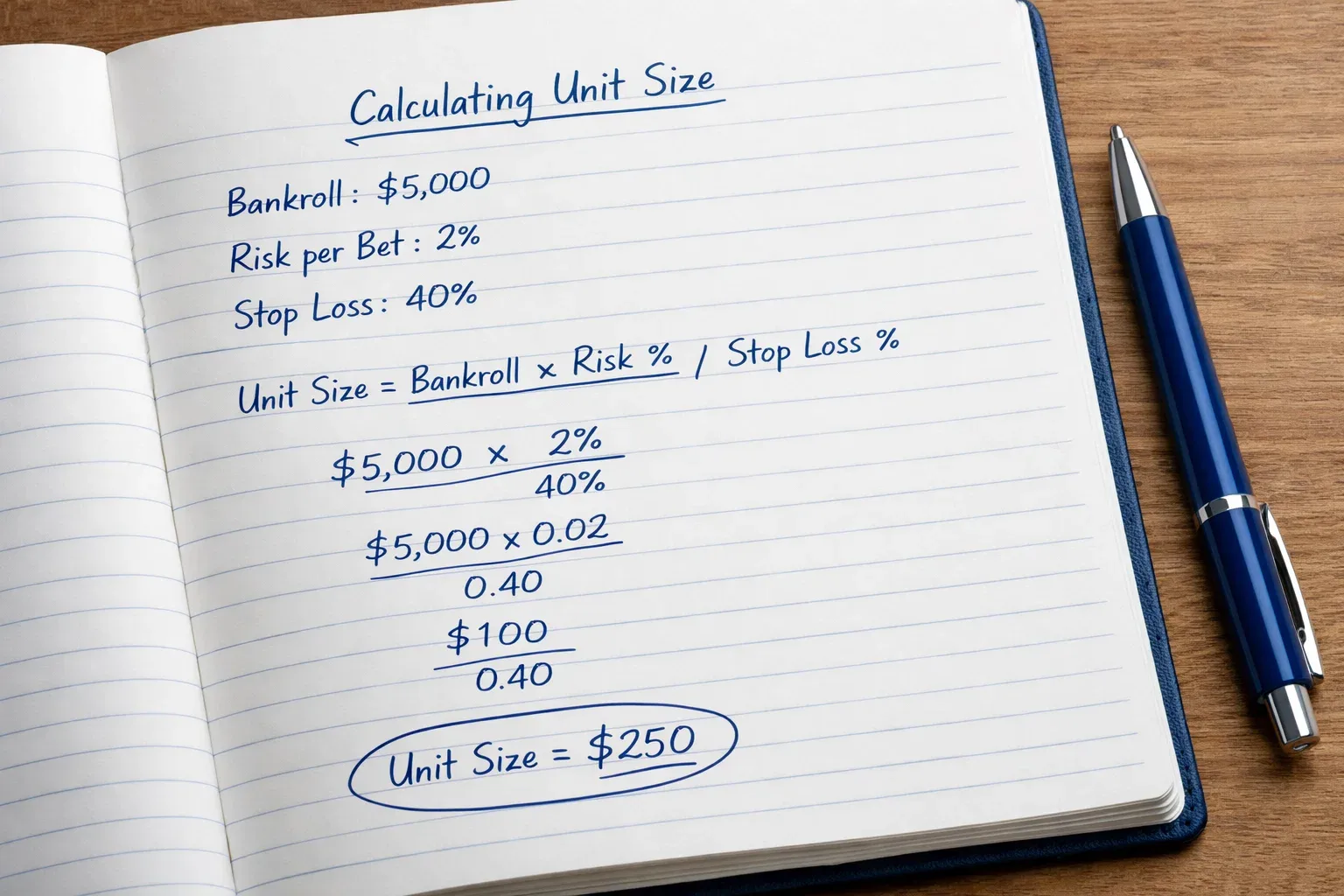
For football betting with typical strike rates around 50-55% at odds averaging 1.90-2.10, unit sizes of 2-3% provide appropriate protection. This allows for inevitable losing streaks while preserving capital for recovery. More volatile betting approaches, such as backing longshots at 5.00+ odds, might warrant smaller 1-2% units to account for their lower strike rates.
Recalculate your unit size as bankroll changes. If you start with £1,000 and 2% units (£20 per bet), but your bankroll grows to £1,500, your unit should become £30. Similarly, if bankroll shrinks to £800, reduce units to £16. This adjustment happens naturally with percentage-based sizing and prevents both under-betting during growth periods and over-betting during drawdowns.
Deposit Strategy and Bankroll Loading
If your initial bankroll requires multiple deposits to reach target size, spread them over time rather than loading everything immediately. This staged approach provides natural pause points for assessment. If early betting goes poorly, you might reconsider the planned total allocation before reaching it.
Never deposit more to chase losses. The temptation after a bad week is to top up the account and “win it back.” This pattern leads to spiralling deposits that can exceed any sensible allocation. Set your bankroll size in advance; stick to it regardless of results until planned review periods.
Some bettors maintain multiple accounts across different bookmakers for odds shopping purposes. In this case, your bankroll spans all accounts, not each individually. If you have £200 at five bookmakers, your total bankroll is £1,000, and units should reflect that total. Don’t treat each account as separate bankroll; this leads to oversizing bets placed at whichever bookmaker offers best odds.
Document every deposit clearly. Record the date, amount, and source of funds. This documentation proves essential for tax purposes in jurisdictions that tax betting profits, for demonstrating betting history to bookmakers who may query account activity, and for your own analysis of whether betting is genuinely profitable or secretly draining other resources.
Profit Withdrawal Strategy
Taking profits feels good but requires discipline to avoid undermining bankroll growth. Never withdraw so much that you compromise your ability to continue betting at appropriate stakes. Withdrawing half your bankroll after a winning month leaves you unable to bet at the unit sizes your strategy requires.
A common approach withdraws profits above certain thresholds while maintaining core bankroll. If you start with £1,000 and it grows to £1,500, you might withdraw £200 while retaining £1,300 as your new working bankroll. This locks in some profit while allowing continued growth.
Monthly or quarterly review periods provide natural withdrawal opportunities. Rather than withdrawing impulsively after winning weeks, assess performance over longer timeframes. This prevents the common pattern of withdrawing after good periods then watching the remaining bankroll decline during subsequent losing streaks.
Some professional bettors treat withdrawals like a salary, taking fixed amounts monthly regardless of performance, so long as bankroll remains above baseline. This approach works best for those with substantial bankrolls and consistent edge. Recreational bettors might prefer performance-linked withdrawals that only occur when specific profit targets are met.
Managing Losing Streaks
Every bettor, regardless of edge, experiences losing streaks. A bettor with 55% strike rate will have runs of five or more consecutive losses regularly over a season. These streaks feel terrible but are mathematically inevitable. Your bankroll management must survive them without enabling destructive responses.
The key is that losing streaks reduce your units proportionally when using percentage-based sizing. Starting from £1,000 at 2% units, ten losses at £20 each leaves you with £800 and £16 units. The damage is significant but not catastrophic. Your ability to continue betting remains intact even after a brutal run.
Never increase unit sizes during losing streaks. The temptation to “win it back faster” leads to exactly the accelerated losses that end betting careers. If anything, reduce unit sizes during extended drawdowns to preserve capital for recovery. A smaller bankroll can still eventually grow; a zero bankroll cannot.
Review your approach after significant losing streaks, but don’t abandon sound strategies based on short-term results. Distinguish between streaks that indicate genuine strategy problems and streaks that represent normal variance. If your analytical approach hasn’t changed and you’ve been unlucky, maintain discipline. If something fundamental shifted, adjust accordingly.
Record Keeping and Performance Tracking
Meticulous records provide the foundation for informed bankroll management. Track every bet with: date, selection, market, odds, stake, outcome, and profit/loss. This data enables analysis that would be impossible from memory alone.
Beyond individual bet records, maintain running bankroll tracking. Know your exact bankroll at all times, not approximate guesses. Weekly snapshots showing bankroll progression reveal trends that daily noise obscures. Monthly summaries provide the big picture view necessary for strategic decisions about deposits, withdrawals, and unit sizing.

Categorise bets by market type, league, and any other dimensions relevant to your betting. This categorisation reveals which areas are profitable and which drain resources. You might discover that your Championship unders are profitable while your Premier League handicaps lose money. This insight informs future betting focus.
Use spreadsheets or dedicated betting tracking apps rather than bookmaker histories alone. Bookmaker records only show activity at that single bookmaker, missing the complete picture for bettors using multiple accounts. Third-party tracking centralises information and enables analysis that bookmaker platforms don’t support.
Long-Term Sustainability Practices
Betting sustainability requires treating it as a marathon rather than a sprint. The goal isn’t maximum profit this week; it’s consistent profitability over years. This perspective shift changes decision-making from aggressive to prudent.
Take breaks from betting periodically. Weekly rest days, off-season breaks, or simply stepping back after particularly intense periods all prevent burnout and provide perspective. The matches will still be there when you return; your ability to assess them objectively benefits from rest.
Never bet when emotionally compromised. After bad losses, after personal stress, after alcohol consumption, during illness, your judgement is impaired. Bankroll management includes knowing when not to bet even when technically possible. Forced absence sometimes protects bankrolls better than any staking system.
Review your bankroll management practices annually. What worked during your first year of betting might not suit your fifth year. As experience grows, skill improves, and financial circumstances change, appropriate bankroll size, unit sizing, and withdrawal strategy should evolve accordingly.
Common Bankroll Management Mistakes
The most destructive error is betting without defined bankroll at all. Reaching into a general account for each bet, with no clear separation or tracking, guarantees eventual problems. You cannot manage what you don’t measure.
Increasing stakes after wins mirrors the error of increasing after losses. Winning streaks feel like skill; losing streaks feel like bad luck. Both are substantially variance. Raising stakes during winning streaks positions you for larger losses when regression hits. Maintain consistent unit sizing regardless of recent results.
Ignoring opportunity cost leads to suboptimal bankroll allocation. Money locked in bookmaker accounts earning nothing might generate returns elsewhere. Keep only enough in betting accounts for planned near-term activity; the remainder can earn interest or returns in other investments between betting cycles.
Treating bonuses as free money distorts bankroll management. Bookmaker bonuses carry wagering requirements that effectively reduce their value. A £100 bonus requiring 10x wagering isn’t £100 of free value; it’s substantially less after accounting for expected losses during wagering. Factor this reality into bankroll calculations.
Psychological Aspects of Bankroll Management
Good bankroll management provides psychological protection beyond its financial function. Knowing that any single bet cannot cause catastrophic damage reduces anxiety. Knowing that your system survives losing streaks reduces panic during drawdowns. The mental freedom of proper management improves decision quality.
The discipline of following predetermined rules removes decision fatigue. If your system says bet 2% on this selection, you bet 2%. No agonising about whether to increase or decrease. This automation of stake decisions preserves mental energy for the analytical work of identifying value.
Accepting that variance exists and that bankroll fluctuates accordingly is essential psychological preparation. Your bankroll will not grow smoothly in a straight line. It will wobble, sometimes declining significantly before recovering. Emotional acceptance of this reality prevents the panic-driven decisions that transform temporary drawdowns into permanent losses.
View your bankroll as a tool for betting rather than a score to maximise. The goal isn’t the largest possible bankroll; it’s sustainable profitable betting activity. Sometimes protecting the tool requires actions that slow growth, like reducing stakes during uncertain periods. The tool’s preservation matters more than its size at any given moment.
Building and Scaling Over Time
Successful bettors eventually face the challenge of scaling. What worked with a £1,000 bankroll might not work with £10,000. Market impact, bookmaker restrictions, and liquidity limitations all affect larger stakes differently than smaller ones.
Scale gradually, testing each new level before committing fully. When your bankroll reaches a threshold where you’d naturally increase unit size significantly, increase by half the indicated amount initially. Observe whether results remain consistent at higher stakes. Some betting edges disappear at larger sizes; better to discover this with partial increases than full commitment.
Diversify as bankrolls grow. Larger bankrolls can support betting across multiple leagues, markets, and bookmakers simultaneously. This diversification reduces variance by spreading exposure across independent events. What feels like overcomplication at small stakes becomes sensible portfolio management at larger scales.
Consider when to stop growing and start withdrawing. Betting for £1,000 monthly profit using £50,000 bankroll represents different life situation than betting for £10 monthly profit using £500 bankroll. At some point, the bankroll size is sufficient for your lifestyle goals, and further growth means accepting continued risk without proportionate benefit. Knowing when you’ve “won” the bankroll management game matters as much as knowing how to play it.
Bankroll management lacks the excitement of picking winners but determines whether your picking skill translates into actual profit. The bettor with modest edge and excellent bankroll management will outperform the brilliant analyst with careless money habits. Respect the boring fundamentals; they’re what separate long-term winners from everyone else.